A pikeman monument in Tralee, County Kerry
I like to write a few articles in my free time. Some have been published and some have not. Most of the articles are Ireland related and generally of a historical or cultural nature. I may be contacted through the email on this site.
Tuesday, August 26, 2014
Rodger Casement
The statue of Rodger Casement at Ballyheigue, County Kerry. A German U-Boat brought him to Ireland and he came ashore in a rubber dingy. The locals informed the British and he was soon apprehended. After a trial for treason he was hanged at Pentonville Prison. His body was reinterred in Ireland in 1965.
Thursday, August 14, 2014
The Irish Brigade Flag, County Galway
Clare's Dragoons
When on Ramilles bloody field
The baffled French were forced to yield,
The victor Saxon backward reeled
Before the charge of Clare´s Dragoons.
The flags we conquered in that fray
Look lone in Ypres choir they say,
We´ll win them company today,
Or bravely die like Clare´s Dragoons.
The baffled French were forced to yield,
The victor Saxon backward reeled
Before the charge of Clare´s Dragoons.
The flags we conquered in that fray
Look lone in Ypres choir they say,
We´ll win them company today,
Or bravely die like Clare´s Dragoons.
The Battle of Ramilles was fought in 1706. The flag pictured above was carried into battle by the Irish Brigade. The Flag is on display at Kylemore Abbey, Connemara, County Galway
The Jeannie Johnson
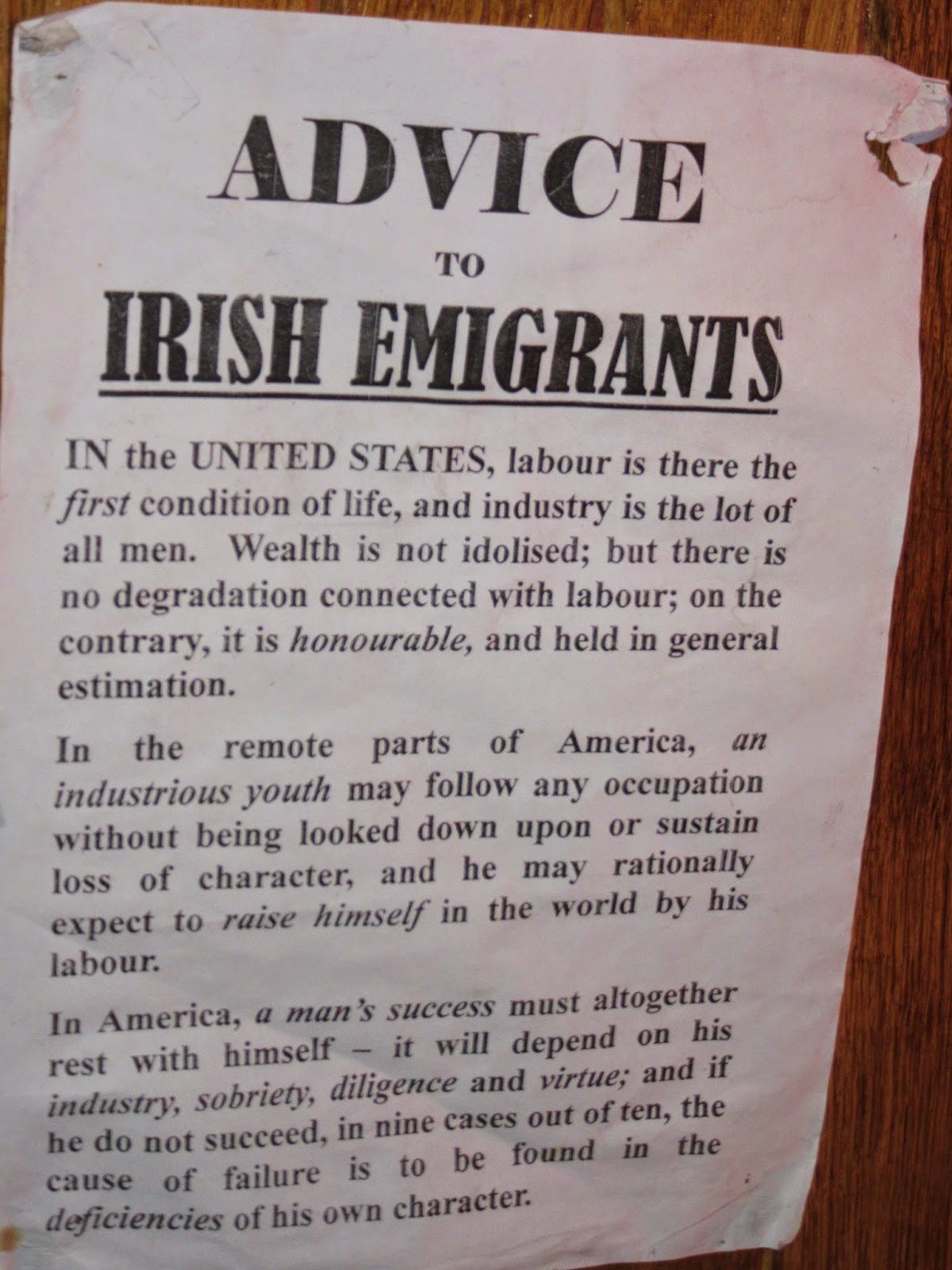
Some advice for those going to the United States in the 1840s.The poster is on display aboard the Jeannie Johnson, a replica "Coffin ship" museum, docked on the Liffey.
An Irish passenger on her way to America
What the passengers got to eat on the voyage, though on most of these ships the food amounted to a starvation ration.
Sheela-na-Gig
The sheela-na gig (possibly from the Irish meaning "Sheila of the breasts") are found throughout the country, usually on churches, though some are also in castles. One possible function was to ward off evil. This particular example is from the Rock of Cashel, County Tipperary.
Stone Fort , County Kerry
The Irish did not live in towns and inhabited earthen or stone ring forts until the collapse of Gaelic society in the 17th century. This example is just outside Waterville, County Kerry.
Subscribe to:
Posts (Atom)