Thursday, July 20, 2017

The Farce of Irish


Irish is the original language of Ireland, a language that sets us apart from the English, but it is also a language that we can neither seem to completely embrace nor completely discard.   Irish is an official language of the EU but it is clearly not a working language in Ireland.

The farce of Irish comes to the fore when you try to do your business in the ‘country’s first official language’. My most recent experience with Irish as a farce was with the NCT, the authority responsible for maintaining road safety of motor vehicles. When booking the appointment online, you can choose between Irish and English, both official languages in Ireland. The NCT inspector will duly inspect your car but when it comes to printing out the report, often cannot hide their disdain when they realise the document they printed out is in Irish, a foreign language in places like Dublin. This is not a problem if you pass, but if you fail, you have to come back and show the inspector the report in Irish. They cannot read their own document and cannot access it in English. You can ring their customer service team and receive blasts of hot air. You can also contact the Irish language commissioner’s office, a watchdog on such breaches of the official language act, which though well meaning, will do the same.
Tourists like to see signs in Irish, even though the Irish written on the sign often makes no sense and whoever translated it obviously used google translate. Dublin airport has produced some dismal examples of this.  Signage in Irish is more often than not for decorative purposes only and serves no purpose for Irish speakers. Even in Galway city, the so-called the bilingual capital. I remember dining in a restaurant in the Bohemian Latin Quarter. The menu was bilingual but when I ordered in Irish, it quickly became clear that the Irish on it was just for show.

The Celtic culture of this land is being pushed to the fringes of society and Irish speakers are becoming strangers in their own country and even mocked for cultivating it. 
I believe a bilingual society is a more open society and it is lamentable that Ireland's attempt is nothing more than farce.


NB: this article is good:   https://whistlinginthewind.org/2015/08/20/why-dont-the-irish-speak-irish/


Tuesday, July 18, 2017

The grave of Arthur Griffith


Arthur Griffith (1872-1922 ) was one of the founders of the Irish state and a founding member of Sinn Féin. He is buried at Glasnevin.

Graves of Glasnevin

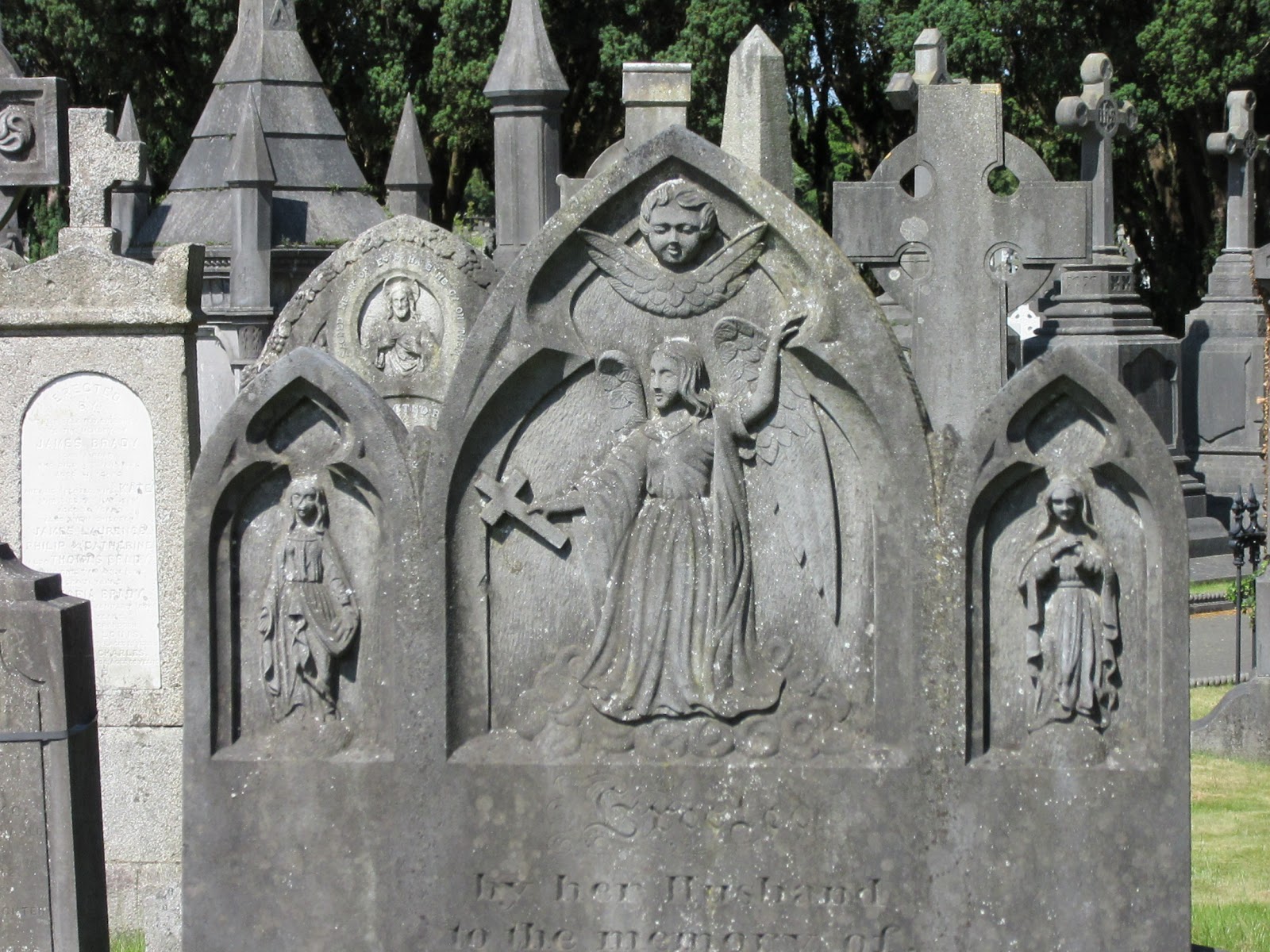
Glasnevin is vast and it would takes several days to go through all the graves of which there are more than a million. The cemetery is run by a private company which has both advantages and disadvantages. A tour of the cemetery is well worth it and the guides are enthusiastic about what they do. The pictures below are a minute taste of the magnificent gravestones on offer there. More to follow.
If I recall correctly, this above headstone dates from 1860, meaning the stone was carved by hand. Its unusual to see a cherub from this time. 


Famine Memorial at Glasnevin, Dublin


Famine Memorial at Glasnevin, Dublin unveiled very recently by President Michael D Higgins. It was only in the 1990s that famine memorials started appearing in Ireland. The famine was for generations a mark of shame. 

Monday, July 10, 2017

Easter Rising Casualty, Galway.


I wrote about the death of constable Whelan in Gone the Way of Truth. He was Galway's first casualty of Easter 1916. He encountered armed rebels in the Carnmore area and was ordered by his superior to talk to to them as he knew many of them. It cost him his life. When I photographed it for the book, it was in an unkempt state but has recently been restored. Great to see the city looking after objects of historical interest of which there are many in Bohermore cemetery.

Galway Sea mine Victims


In 1917,  a sea mine washed ashore at Lochán Beag near Spidéal, county Galway. It may have been German or British, we don't know for sure but when it struck a rock, it cost the lives of 17 locals, the remains of whom are buried at Bohermore cemetery in Galway. It was recently the subject of a play by the theatre company Fibín. See also Gone the Way of Truth page 123.

Thursday, July 6, 2017

How to write Irish names properly

People might have noticed that some Irish surnames are written with an apostrophe and some are not, take for example O'Donnell and Ó Domhnaill. The apostrophe does not belong in Irish here and it is lamentable that Irish people do not know this. The 'ó' means 'descendant of' . Irish people greet the the Irish version with aversion and try to translate it as they cannot accept that other Irish people want their name in the original Irish.
Mac means 'the son of' an dis sometimes anglicized as "Mc" which loses all meaning. Several thousand Irish dropped the 'o' and  'mac' from their names when they went to America so their names would appear less Irish. the old families are believed to have a banshee attached to them. An old poem went as follows:


Per O' atque Mac, veros cognoscis Hibernos;
His duobus demptis, nullus Hibernus adest.

Which has been translates as

"By Mac and O' you'll always know
True Irishmen, they say:
But, if they lack the O' or Mac,

No Irishmen are they