I like to write a few articles in my free time. Some have been published and some have not. Most of the articles are Ireland related and generally of a historical or cultural nature. I may be contacted through the email on this site.
Wednesday, July 30, 2014
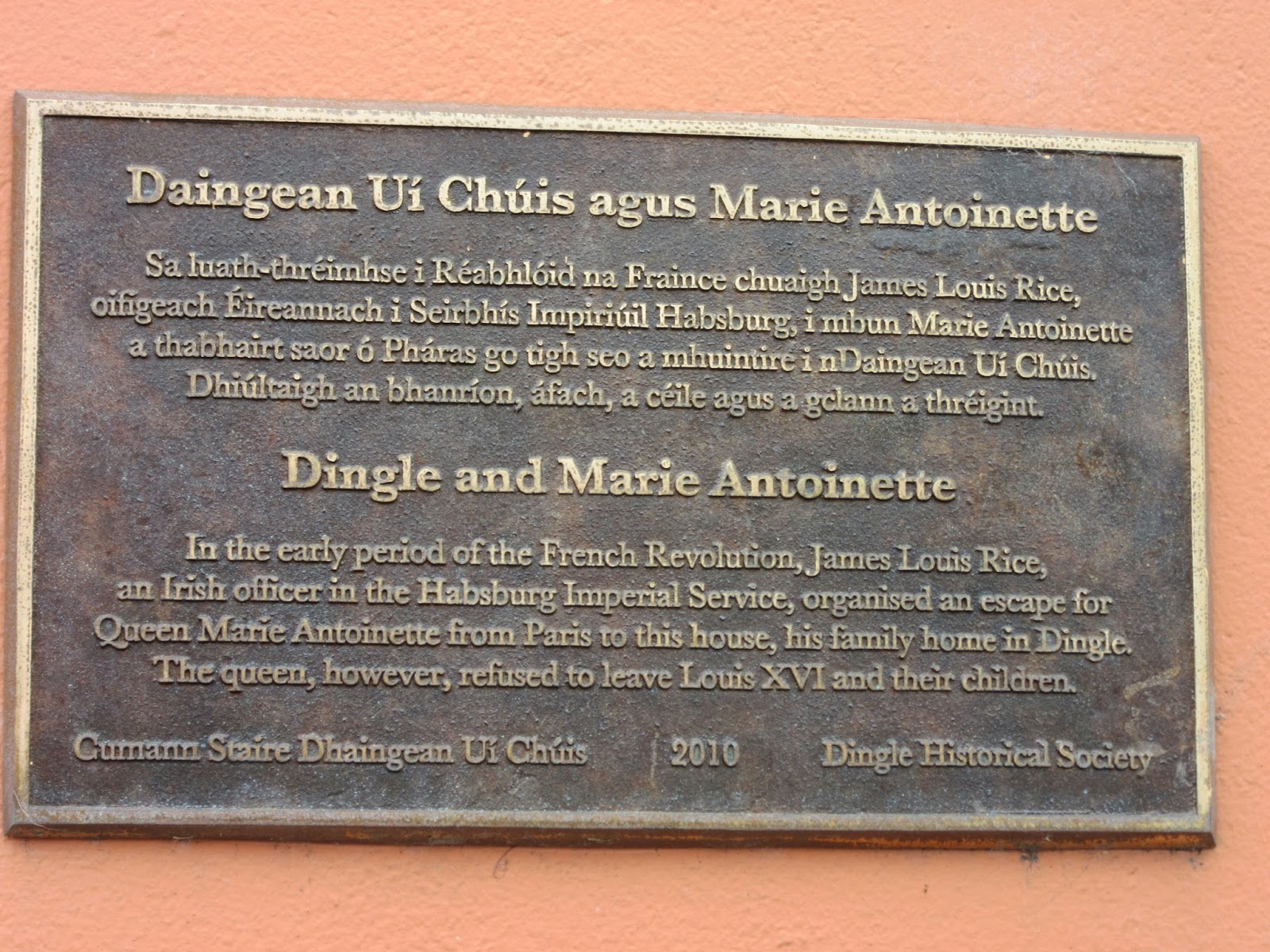
Marie Antoinette and Dingle
This unassuming Georgian house in Dingle was refurbished inside in the French style in preparation for an important guest-Marie Antoinette. It was one of several plans to free the royal family and a Kerryman had a ship waiting to take her to Dingle. Everything was planed and the jailers had been bribed, but she she refused to leave her family. For more see page 107 of Fadó-Tales of Lesser Known Irish History.
Irish Palatines
Adare, County Limerick-Aunty Lena's Pub, established in 1806, a remnant of the German Palatines.
See page 72 of Fadó-Tales of Lesser Known Ireland.
Saturday, June 7, 2014
The Lucky Stone of Medieval Dublin
The Lucky Stone
The above stone, dating from around the 9th century used to be part of the Slí Mor or medieval highway, the remains of an esker, which possibly ran from the Brazen Head west as far the Shannon to the settlement of Clonmacnoise and continued on into the West. Pilgrims setting out on the journey to Clonmacnoise would rub the stone and pray for a safe journey reciting the ancient "Tonga na Dia thungus mo thuath"(I swear by the God my people swear by). In 1308 a marble cistern, providing a public water supply, was erected at the Cornmarket and the stone placed beside it. It was considered lucky to drink here. In 1826 the stone was stolen but the thieves had no luck and it apparently became heavier until they were forced to abandon it. When workmen attempted to break it up it was said to have rolled and moaned.It has been at its current site since 1860
The Stone is located at St Audeons in the heart of Medieval Dublin. Admission is free
Thursday, June 5, 2014
John Bodkin's Hand
"If the old stones of Saint Nicholas Collegiate
church could speak, what strange tales they would tell of war and peace,
prosperity and adversity, civil and religious strife, of self-denying devotion
to the service of God and rash sacrilegious spoliation"
Rev J. Fleetwood
Berry, Rector of Galway 1912
Tuesday, June 3, 2014
She Weeps over Rahoon
James Joyce
Rain on Rahoon falls softly, softly falling,
Where my dark lover lies.
Sad is his voice that calls me, sadly calling,
At grey moonrise.
Love, hear thou
How soft, how sad his voice is ever calling,
Ever unanswered, and the dark rain falling,
Then as now.
Dark too our hearts, O love, shall lie and cold
As his sad heart has lain
Under the moongrey nettles, the black mould
And muttering rain
Where my dark lover lies.
Sad is his voice that calls me, sadly calling,
At grey moonrise.
Love, hear thou
How soft, how sad his voice is ever calling,
Ever unanswered, and the dark rain falling,
Then as now.
Dark too our hearts, O love, shall lie and cold
As his sad heart has lain
Under the moongrey nettles, the black mould
And muttering rain
Friday, May 2, 2014
Lili Marlene
Lili Marlene
Rónán-Gearóid Ó Domhnaill
Underneath the lantern by the barrack gate,Darling I remember the way you used to wait, 'Twas there that you whispered tenderly, That you loved me, You'd always be,My Lili of the lamplight, My own Lili Marlene
Lili Marlene undoubtedly ranks as the most famous song of The Second World War. It became the unofficial song of both the Germans and Allies and had many different versions, some designed to promote longing and love, others hatred towards the foe while others were anti-war.
The song was originally written by Hans Leip (1893-1983) in 1915, who was a young soldier about to go to war. What he experienced at the front horrified him and he often reminisced of happier times when he stood on guard duty and caught a glimpse of his girlfriend and wondered if he would survive the death and destruction that surrounded him. Amidst the horrors of war he longed to be with her once more, a longing his generation and the next one could readily identify with. The name Lili Marlene was a combination of the name of his girlfriend Lili, with that of his friend’s girlfriend Marlene.
It was published as a poem in 1937 under the title of 'The Song of a Young Sentry' when it caught the attention of the composer Norbert Schultze who wrote music to ita and in 1938 and got Lale Andersen to sing it. It was first sung at a cabaret but this version was forbidden due to its anti-war message, one of the verses which ran:
Who recovers the bodies,Lost in desert sands?Who counts the victimson the oil-soaked beaches?Tell me, how much pain must pass,'til we see the waste and stupidity of it all?Oh God, Lilli Marleen
It landed Schultze in hot water with the authorities and in order to appease the Propaganda Ministry who could make or break his career he later came up with marches such as 'Bombs for England', which in turn landed him in trouble with the English after the war.
When the song was released it didn’t prove popular. The propaganda minister Josef Goebbels wanted to make a march out of it, which Andersen didn’t want and no radio station wanted to play it. When it was launched it only sold 700 copies.
In 1941 when the Germans occupied Yugoslavia they set up a radio station in Belgrade to broadcast to their troops. It was powerful enough to broadcast to most of Europe. Lieutenant Karl-Heinz Reintgen had the job of running the tiny station with rather limited resources. After the radio station was bombed he was left with only five records, three of which were banned. Therefore Reintgen had no option but to play the same two records again and again. It was assumed that the station in Belgrade would have a very limited audience and he played the Lili Marlene for his friend serving with the Afrika Korps who liked the song very much, until he couldn’t take it anymore and resolved never to play it again. What happened next shocked him. The station was inundated with letters and telegrammes from all over Europe requesting the song be played. One of the letters was even from an American, although America was now at war with Germany, requesting that Reintgen play a request for a friend of his. At the time the song was not been played in Germany as the propaganda ministry felt that the sad song was bad for morale and Andersen herself was forbidden to perform as she was consorting with Jews. Now everyone in Germany wanted to hear her sing it and the authorities were forced to back down. Field marshal Rommel also ranked among the legions of fans of the song and requested that it be permanently integrated into the programme. Thus every evening at 9:55, just before the station went off air the sad song echoed over the deserts of North Africa and soldiers on all sides listened in. For a brief moment they could reminisce about they love they had to leave behind back home. The station also proved to be a way of contacting the Allies. On one occasion an RAF pilot, who had been shot down was brought into the station under guard. He had been posted as missing and was anxious that his pregnant wife back in England know that he was alright.
The popularity of the song meant that it could be used for propaganda purposes and the BBC came up with a German version with a subtle anti-Hitler message, to remind the German troops that due to Hitler, their wives were suffering alone at home with the hardships of war. The British were becoming concerned that their soldiers were whistling and singing a German song and when several English soldiers were given a dressing down they responded by saying that someone should write an English version of it.
In 1944 Tommie Connor did just that and composed the English text in only 25 minutes. It was first sung in English by Anne Shelton. Over a million records of the song were sold in a month. It was also sung by Vera Lynn, Edith Piaf, Amanda Lear, Bing Crosby and Perry Como but it was Marlene Dietrich who immortalised the song for the Allies. Dietrich was originally from Germany but joined the American forces to help the fight against her fellow countrymen, something that Germans never forgave her for. She entertained the Allied troops with ‘The Girl under the Lantern’ both on radio and live performances in North-Africa, Sicily, Italy, Alaska, Greenland, Iceland, and England over a three year period. The theme of a soldier longing for his love was something people all over the world could understand, especially in a time of separation that the war had brought.
By the time the war had ended the song had been translated into 48 languages and its popularity didn’t show signs of waning. As late as the 1980s it was still been re-released into the charts. Never before had a single song captivated so many people and it has yet to find its equal.
Saturday, April 26, 2014
Isolde of Dublin
The modern Dublin suburb of Chapelizod hardly gives any indication to any ancient link to one of Europe’s most famous love tales Tristan and Isolde. Many, including the Dubliners themselves, are unaware that the place name has nothing to do with lizards and the heroine of the Europe’s most tragic love tales was a Dubliner. I have followed the tales for years and my interest in it was first awoken while doing a seminar on Tristan and Isolde at the University of Vienna many years ago. It was there that I first became familiar with the Celtic roots of the story, which tied into my research on Irish legends. Chapelizod is said to be the burialplace of the Viking princess, though no known grave is known to survive.
Her name has several spelling variations as Iseult and Yseult. We have no proof that she ever existed. According to the popular legend Isolde was a Viking princess from Dublin and the daughter of an Irish king, King Aonghus who is supposed to have lived before the Vikings established the settlement of Dublin in 988 where the Dublin City Municipal Building now stands. Nobody knows for sure just how old the tale is, but the more ancient elements probably have Pictish roots.
The version of the tale I am most familiar is probably also the most complete and was written by Gottfried von Strassburg around 1215. It was this version that Richard Wagner used when he composed his famous opera Tristan and Isolde. It is essentially a mishmash of various Celtic legends and time. For example Isolde is obviously a Viking name, yet French is according to Gottfried the language spoken in Dublin. Earlier versions were composed by Thomas of Britain around 1160 and the 12th century Norman poet Béroul. A film version, albeit one very loosely based on the original tale, was made in 2006 with Sophia Myles playing Isolde.
The tale is something of a ménage à trois between the elderly King Mark of Cornwall, his nephew Tristan of Brittany and Isolde. Isolde is depicted as having fairy like beauty and both she and her mother, also called Isolde, have healing powers. After Tristan does battle with Morholt and beheads him, with echoes of the immram, he wanders adrift in a boat eventually reaching the Irish coast, where he is healed by Isolde. Mark wants to marry Isolde and sends his nephew to woo her on his behalf. There are parallels here with Diarmaid and Gráinne and Deirdre and Naoise. Indeed, Ireland of the 10th century had a wealth of love stories, many of which have long been forgotten. Brangaine, Isoldes’s lady-in-waiting is given a love potion which will make Isolde fall in love with the elderly king. Tristan and Isolde en route to Mark drink the love potion by mistake and fall for each other. They try to hide their love but find it impossible. Mark is furious and banishes his beloved nephew. The two lovers go on the run and are pursued by the jealous Mark and the tale inevitably ends in tragedy.

To give an indication of how old the tale could be a 9th century tower in the present Temple Bar area, called Isolde’s Tower, later rebuilt by the Normans formed part of the Dublin city wall. The river Poodle flowed by its walls. The Poodle itself, part of Dublin’s medieval heritage was forced underground as the city modernised. It rises in the Cookstown area of Tallaght and flows underground through a culvert where it enters the Liffey at Wellington Quay. The tower was demolished when the city walls were removed. Its remains were rediscovered when building work was been carried out between 1993-1997. The modern development was named duly Isolde’s Tower, but the actual remains were hidden away once more behind an iron grill. The developers were supposed to leave access to the Tower but the gate is always locked and a cultural aspect dating from the foundation of the settlement of Dublin itself has been pushed aside. The street leading up to where the tower once stood, Upper Exchange Street, was until recently, in a nod towards the past, called Sráid Iosóilde Uacht. (Isolde’s Street Upper). In a further blow to the city’s cultural heritage reference to Isolde has been recently removed from signage.
.jpg)
.jpg)
.jpg)
Sources:
http://www.patrickcomerford.com/2012/09/in-search-of-isolde-and-her-lost-tower.html
Ó Conghaile, Secret Dublin an Unusual Guide
Subscribe to:
Posts (Atom)


.jpg)